

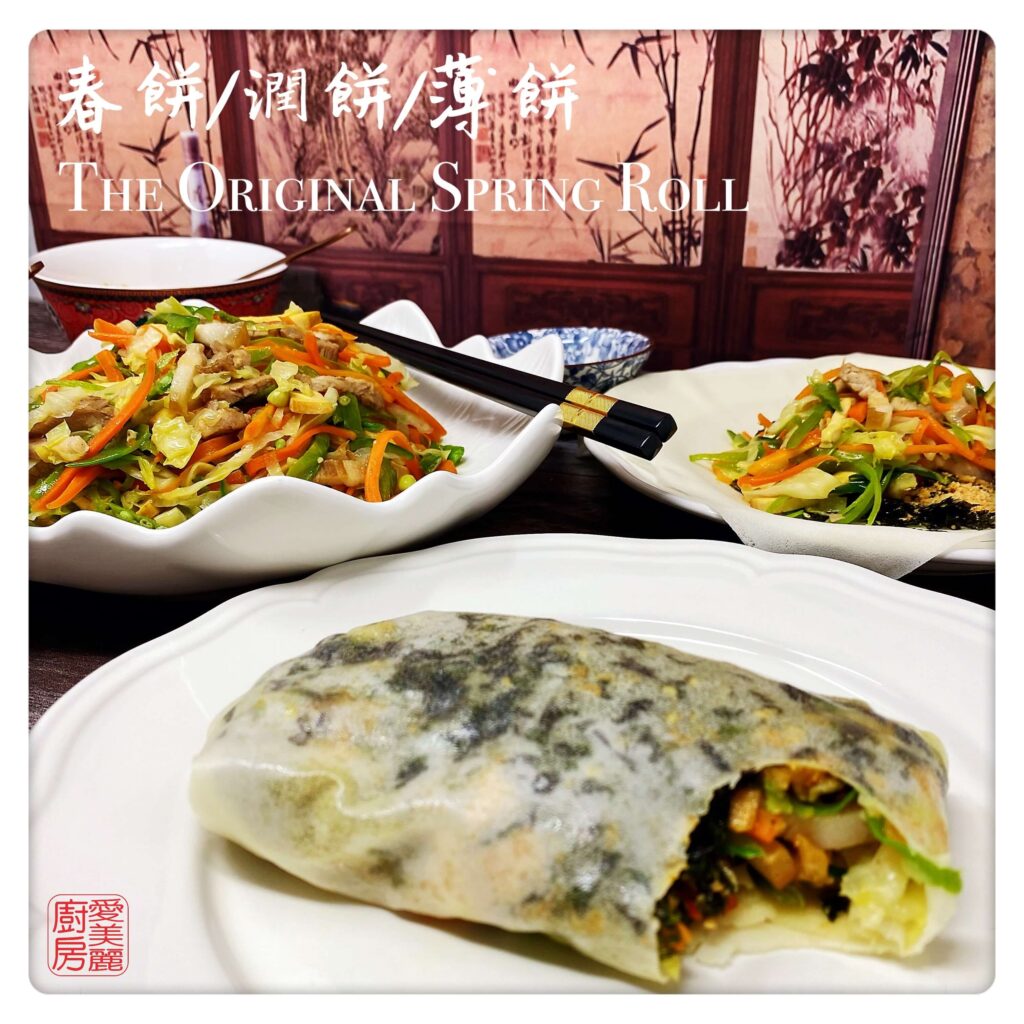
The Original Spring Roll 春餅/潤餅/薄餅 (chūn bǐng/rùn bǐng/bó bǐng) is the spring roll that existed 3000 years ago. (I call it the “original” spring roll to differentiate it from the common deep-fried ones that are popular today.) Ancient Chinese astrologists would forecast the first day of spring by making calculations by looking at the angle of the sun and the position of the big dipper. “Li Chun 立春” is the first day of spring and also a day of celebrations. We can find this day on the Chinese Farmer’s Calendar. It is also the first celebration of the year. China was an agrarian society so the coming of spring was very important. It meant planning and preparing seeds to plant for the year. Everything began in the Spring.
During the Zhou Dynasty, thin pieces of rice flour dough were made into pancakes. You would then use them to wrap various meats and/or vegetables. People would eat these to celebrate Spring, hence the name Spring Roll 春餅.
It was during the Ming and Qing Dynasties where the Original Spring Roll 春餅 gained tremendous appeal. Emperors would prepare Li Chun 立春 gift boxes for their beloved officials and royal families filled with luxuriously prepared fillings like deer meat, smoked pork, wild duck, specialty chicken, pigeon, green bean powder and various vegetables. For the commoners, they were eating the Original Spring Roll 春餅 as well. People's budget determined the filling. Some common fillings include braised pork (like pulled-pork), lettuce, white radish, chives, leeks and preserved vegetables.
In the late Qing Dynasty, people began to deep-fry the spring rolls. They were called 春卷 (chūn juǎn) which literally translates to “Spring Roll”.
In many regions of China, the Original Spring Roll 春餅 has been somewhat forgotten and its successor took its place. With industrialization and people moving into the cities, the once important Li Chun 立春 has also fizzled.
Although some have forgotten this once very important dish, there are still many places in China that make it and serve it. It’s very popular in the province of Fujian. In Fujian, they call it “Run Bing 潤餅” (rùn bǐng). In one of the Fujian dialects commonly known as Hokkien, the pronunciation is “lun bia”. And if anyone is familiar with the Filipino spring roll, they call it “lumpia”. Some of the first Chinese migrants to the Philippines were from Fujian and this is why some Filipino foods have a Fujian flair to them. This is the same in Fujian, where you can find many Filipino food products.
My mother-in-law gave me this Original Spring Roll 春餅/潤餅/薄餅 recipe. It is Xiamen style. This was also my husband’s favorite dish, besides steak. However, I’ve simplified this recipe a bit to make it easier and to cater to what is readily available here in Canada. I hope you’ll give this recipe a try because it comes from antiquity, which I find pretty cool! So we have to keep it alive!
To learn more about Spring Festival, check out my Chinese New Year 101 page or view all my Chinese New Year recipes.
The Original Spring Roll 春餅/潤餅/薄餅
Ingredients
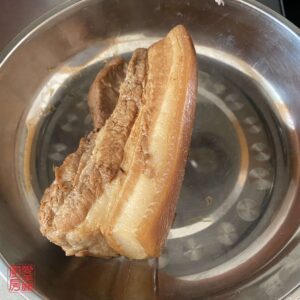
- 450 g Pork belly
- 600 g Cabbage (shredded)
- 300 g Snow peas (shredded)
- 400 g Carrots (shredded)
- 140 g Pressed tofu
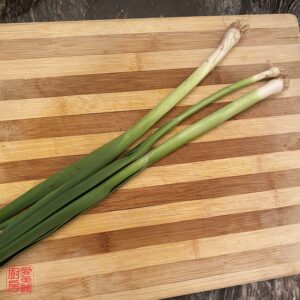
- 3 stalks Chinese leeks
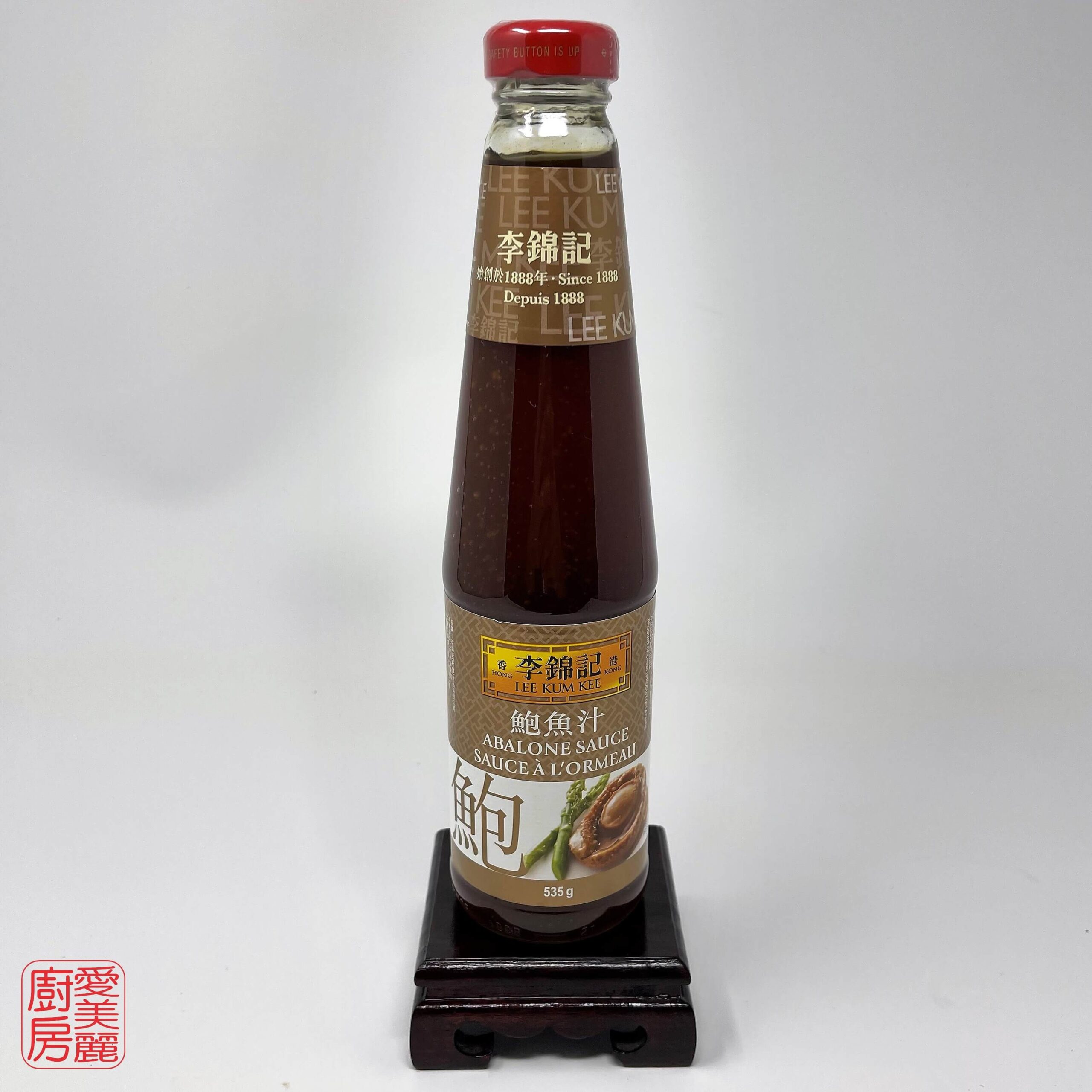
- 3 tbsp Abalone sauce
- 2 tbsp Shaoxing wine
- ¼ tsp White pepper powder
- 1½ tsp Salt
- 4 tbsp Oil
- 1 pkg Spring roll wrappers (I used 8.5” wrappers)
- 1 cup Seaweed flakes (ready-to-eat)
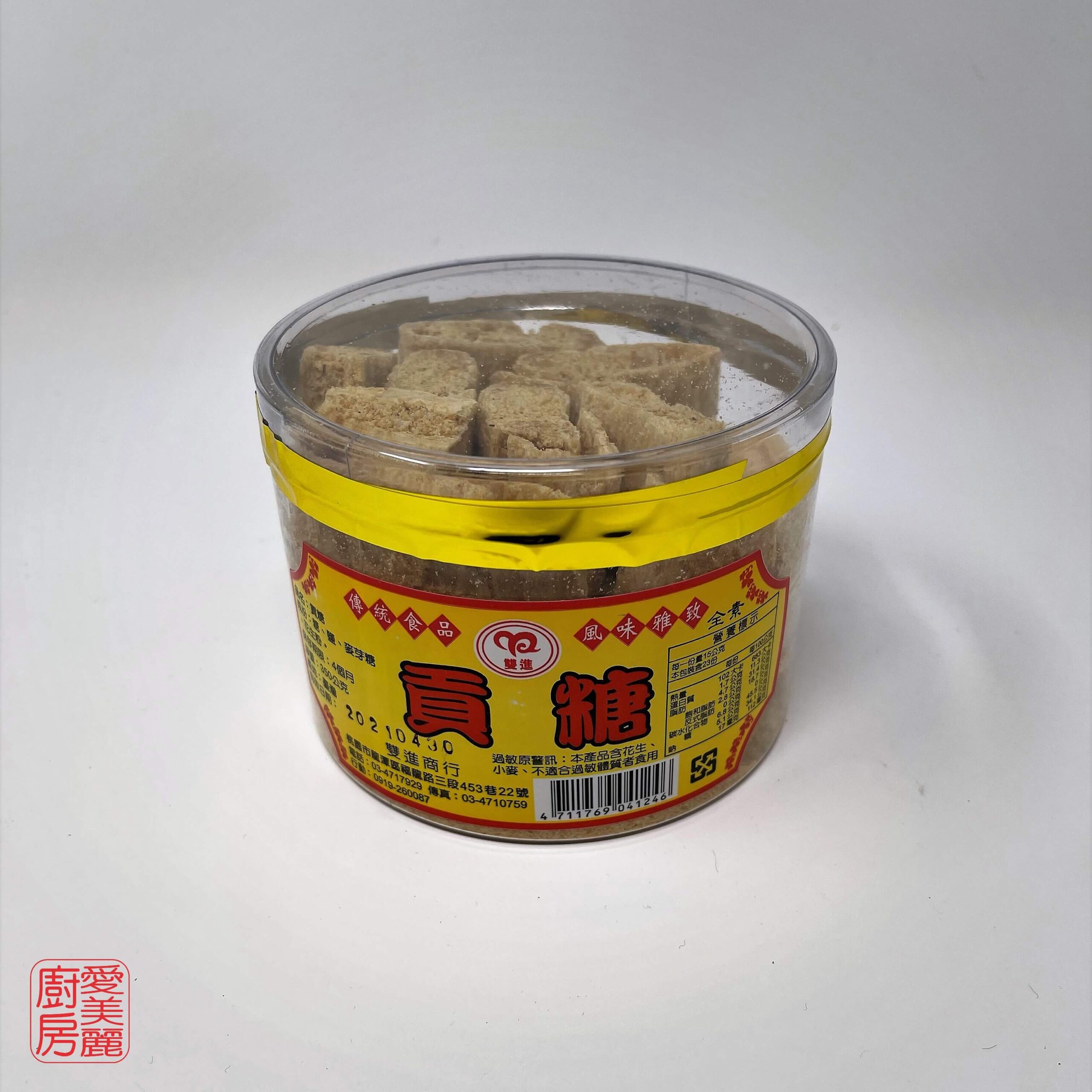
- ½ cup Peanut candy (ground) or peanuts
- 1 tbsp Tabasco or your favorite chili sauce or hoisin sauce
Ingredients for Braising Pork Belly (optional)
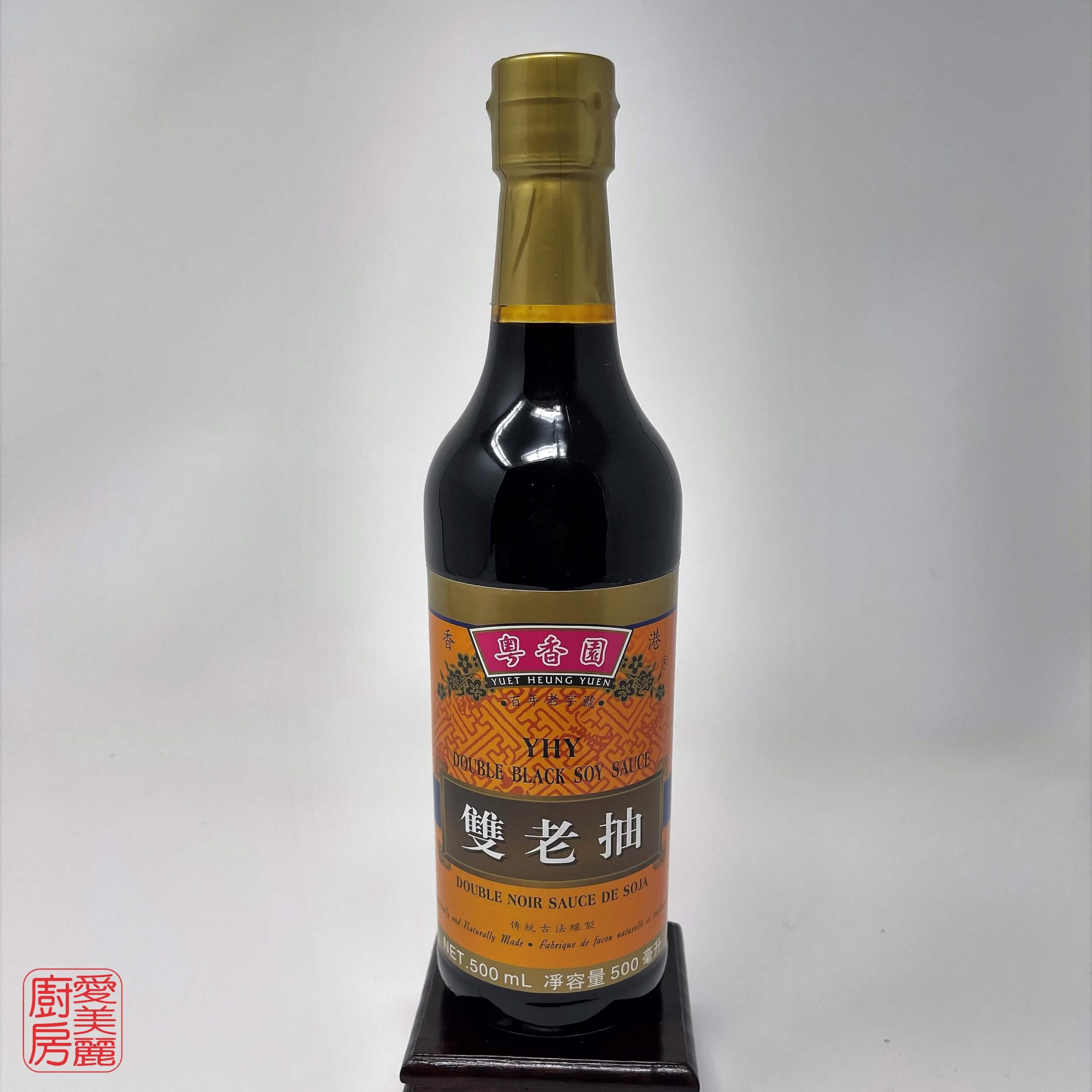
- 1 cup Light soy sauce
- 1 cup Dark soy sauce
- ¼ cup Shaoxing wine
- 2 cup Broth or water
- 40 g Rock sugar (cane) (or 4 tbsp sugar)
- 2 tsp Salt
- 2 Star anise
- 6 Cloves
- 4 Bay leaves
- 1 slice Ginger
- 1 Cinnamon stick
Instructions
Instructions for Braising Pork Belly (optional)
- In a pot, combine 1 c light soy sauce, 1 c dark soy sauce, ¼ c Shaoxing wine, 2 c water or broth, 40 g rock sugar (or 4 tbsp sugar), 2 tsp salt, 2 star anise, 6 cloves, 4 bay leaves, 1 slice of ginger and 1 cinnamon stick.
- Bring the mixture to a boil and simmer for 20 minutes.
- Brown the pork belly then put it in with the braising liquid

- If the pork belly is not completely covered, turn the pork belly every 5 minutes for even cooking. Braise the pork belly for 20 minutes.
- Remove pork belly and let it cool before slicing.
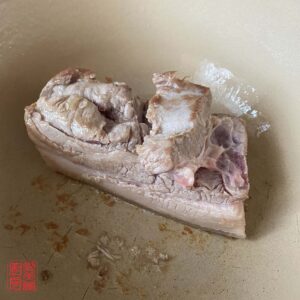
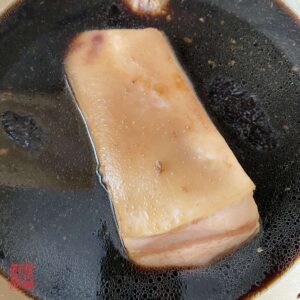
Instructions:
- Wash and pat dry pork belly with a paper towel.
- If you will be braising the pork belly, use the ingredients and instructions above. If you will not be braising, then fill a pot with water, enough to cover the pork belly, and bring the water to a boil.
- Put the pork belly into the boiling water for 3 minutes, remove from water and let cool
- Break off the ends of the snow peas and pull the side fibers off as well.
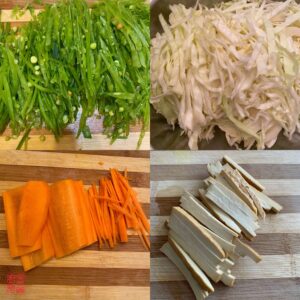
- Wash and cut the cabbage, carrots, pressed tofu, snow peas into thin shreds. You can use a grater for the carrots. Set aside
- Wash and cut the Chinese leeks to 5 cm pieces
- After the pork has cooled, cut it into thin shreds
- If you didn’t braise the pork, marinade it with 1 tsp sugar, 1 tsp cornstarch, 1 tsp light soy sauce; mix well and set aside. If you did braise then there’s no need to marinate
- Heat your wok to high (or medium-high if high heat is not suitable)
- Add 2 tbsp of oil into wok
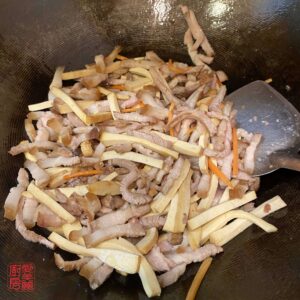
- Add shredded pork into the wok and stir-fry for 2 minutes if not braised and 1 minute if braised
- Heat wok or fry pan to high (or medium-high if high heat is not suitable)
- Add 2 tbsp oil to the wok
- Add marinated pork. Let the pork sit in the wok for 30 seconds and then flip it over and let it sit for another 30 seconds then start stir frying until cooked and remove from heat
- Add pressed tofu into the wok. Stir-fry for 1 minute, and move everything to one side of the wok
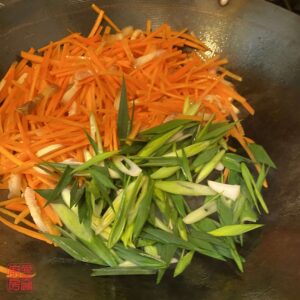
- Add carrots and stir fry with the other ingredients. Then add leeks and stir fry until the carrots start to soften. Turn down heat and remove everything from the wok
- Add 2 tbsp of oil to the wok
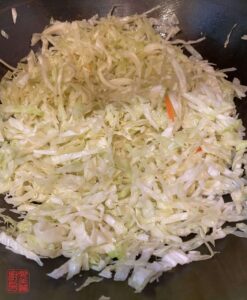
- Add cabbage to the wok and stir-fry

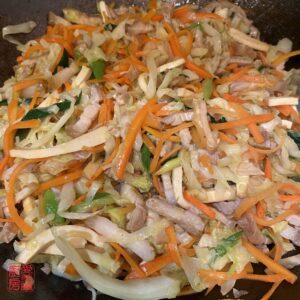
- Once the cabbage begins to soften and shrink, add the other ingredients back into the wok.
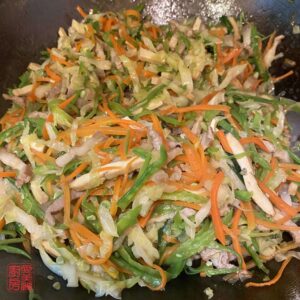
- Add 2 tbsp Shaoxing wine, 3 tbsp abalone sauce, and 1 ½ tsp salt. Stir-fry until everything is well mixed.
- Add snow peas. Stir-fry for another 4 minutes or until everything is cooked and softened
- Transfer onto a serving plate
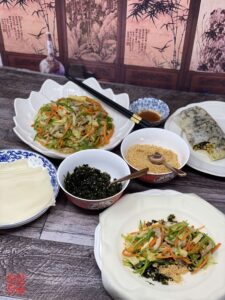
- Serve with spring roll wrappers (they are pre-cooked and ready to eat), seaweed flakes, ground peanut candy and tobacco sauce (any chili sauce) or hoisin sauce

- To wrap: seaweed goes down first to prevent moisture from getting to the skin, then ground peanut candy, then the filling and sauce. Fold the bottom upwards first then the two sides and the top can be left open or folded down






Hi thank you for sharing this on your blog. I agree that the spring rolls were not fried. I am a 7th generation overseas Chinese from the fujian province. Very popular is the spring rolls which is rather similar to your recipe except we tweak the ingredients which are easily available in Singapore like jicama cooked and topped with cooked prawns, fresh lettuce, shelled crab meat etc. We hokkiens called it poh piah or pao ping. The skin is paper thin made with flour or eggs .
Hi Linda! Wow! 7th generation?! It's awesome that you're still keeping the tradition alive! My in-laws are from a town near Xiamen currently living in Hong Kong. They call it lun bia in Xiamen dialect. In Cantonese, they call it bok beng 薄餅 which I think is the same as your poh piah or pao ping. I find it a shame that not more people know about this dish, so I really wanted to put it on my blog. This dish is so versatile....so many different things you can put in it. Someone told me that in Fuzhou, they put fried rice vermicelli in it. Your version sounds delicious too! Thanks for sharing!
I am wondering where you source your seaweed flakes? I heard that you can only get it from Amoy?
Hi Deb, I don't have any on hand right now but lately I've been using a Korean one I got from Costco. It's seaweed flakes, some sesame and salt. I find that it works quite well too. You can probably find something similar at an Asian grocery store. If all else fails, you can buy some seasoned read-to-eat seaweed and crush them up yourself. Hope this helps! Happy cooking!