
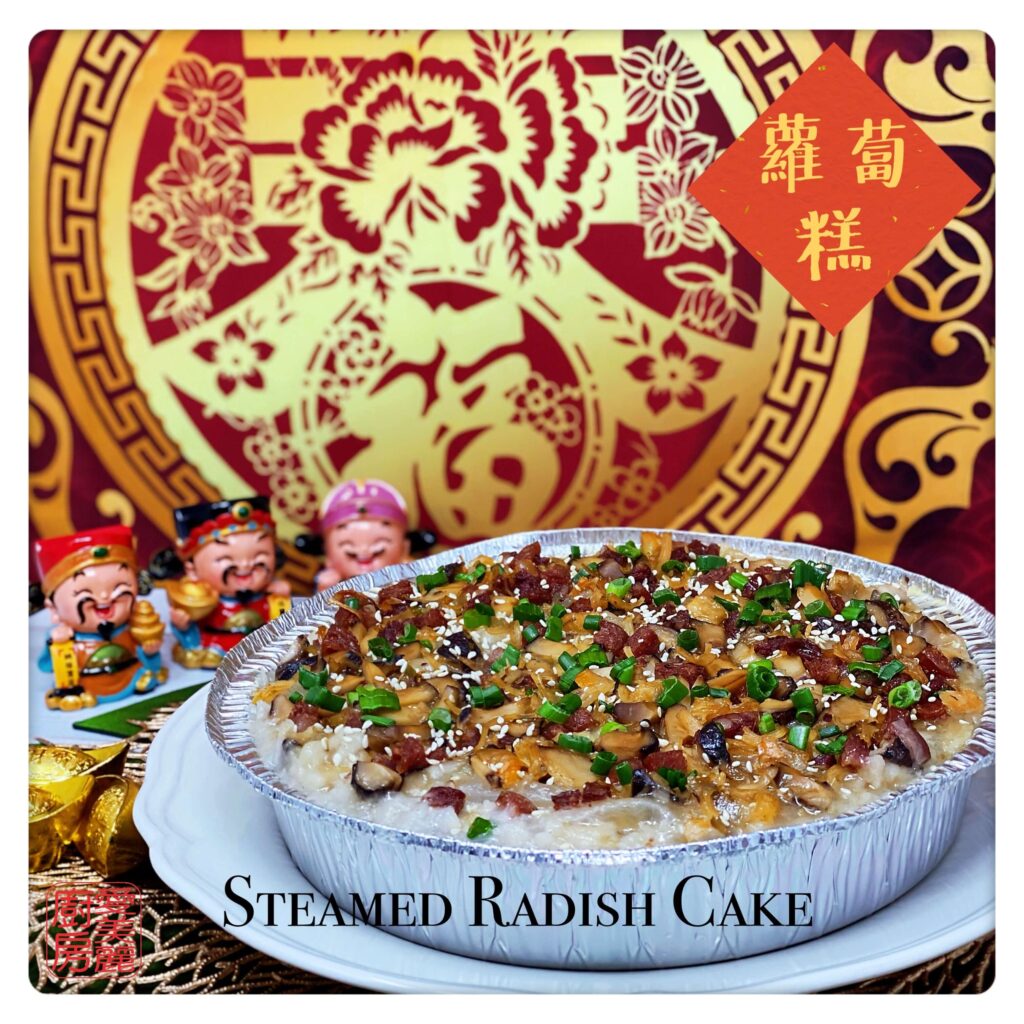
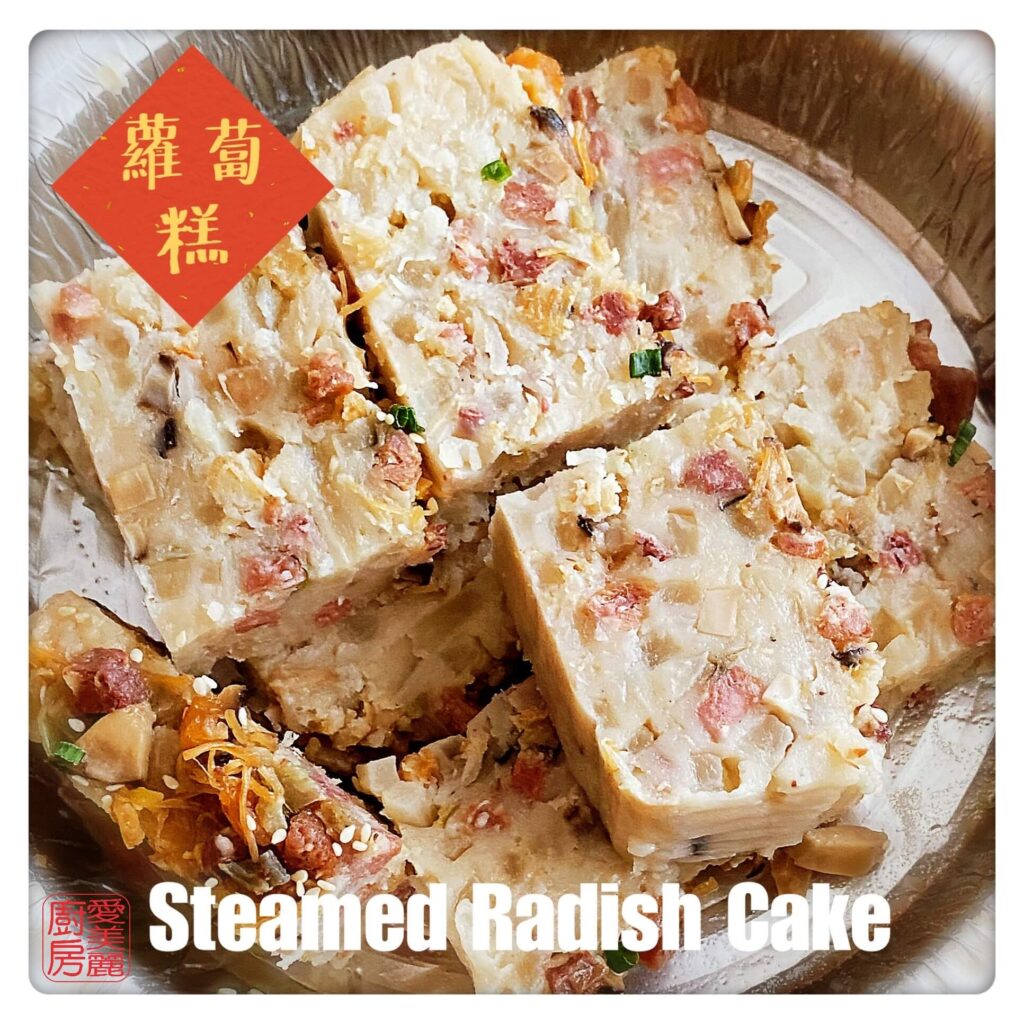
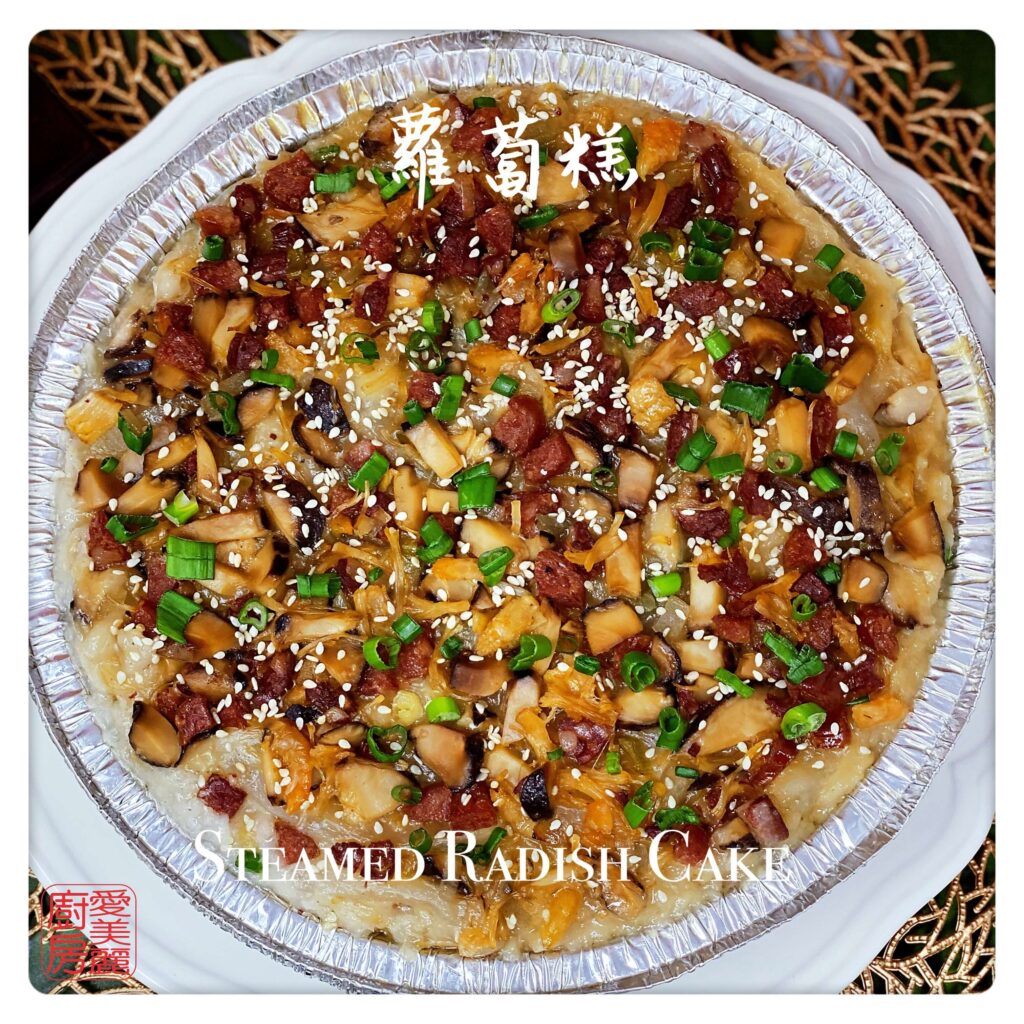

Steamed Radish Cake 蘿蔔糕 (luó bó gaō) is a classic Cantonese delicacy that dates back to the Zhou Dynasty. It is also a 年糕 (nián gaō) or a New Year Cake. It’s a marriage between the rice cake and the Chinese radish which has stood the test of time, 3,000 years that is!
The radish has another name, 菜頭(cài tóu) which sounds very similar to 彩頭 (cǎi tóu) meaning “bearer of good luck”. The word 糕(gaō) means cake or pudding. It has the same sound as 高(gaō) which means “high” or “tall”. So, the Steamed Radish Cake 蘿蔔糕 is an auspicious dish that symbolizes the good fortune of growing tall, getting promoted to high levels and investments that keep going up. No wonder the radish cake is an absolute must during Chinese New Year. It’s a common gift to give to friends and family because who wouldn’t welcome the “bearer of good luck”?!
In my New Year Rice Cake post, I wrote about one story of how the rice cake came to being. Since the radish cake is also a Chinese New Year rice cake, here’s a popular story of how Chinese New Year celebrations came to being…
During ancient times, it was a legend that a beast named Nian 年 lived in the sea. He came up to feast on humans and livestock once a year on New Year's Eve. He had horns on his head and very sharp teeth.
On one particular New Years Eve, in Peach Blossom Village, the villagers were all hectically packing up their belongings. They are rushing to hide out in the mountains to avoid Nian. An old man came into the village but nobody had time to properly greet him. One elderly woman offered him some food. She tried to persuade him to go up to the mountains to hide from the beast with everyone else. He said that if she would let him stay in her house for that night, he would be able to get rid of the beast forever. The elderly woman saw that he made up his mind so she let him be.
That night, Nian the beast came out of the sea and noticed that there was something different about the village. There was light coming out of one house. As he got close to the house, he saw red paper with sayings written on them and the doors opened. Nian saw brightly lit candles and heard fire crackers which scared him off.
On New Year's Day, the villagers were happy to see that everything was the way it was. It was like Nian never came. They couldn't find the old man either. The elderly woman told all the villagers about what the old man told her and showed them the red paper on the doors, the candles and the lit firecrackers. She explained that these were the things that must’ve scared Nian away. The villagers then went off to visit their friends and families to see how they were. They told everyone the secret of how to defeat Nian. This secret spread through China and the tradition of celebrating Chinese New Year began.
There’s a pretty interesting video that I saw that gives a slightly more imaginative portrayal of Nian released by Apple. Click here for the video.
My Steamed Radish Cake 蘿蔔糕 recipe is a bit long but if you’re new to making radish cake, it can help you reduce the risk of having a dry or wet radish cake. Once you’ve made it, you’ll know what an easy recipe it is. A big problem with many recipes is that radish can vary in water content depending on where it's from, how fresh it was and its species. In the recipe, I’ll show you how to determine if you need more water, less water and the secret ingredient that can give you some insurance for making the perfect Steamed Radish Cake 蘿蔔糕!

Steamed Radish Cake 蘿蔔糕
Ingredients
- 1.2 kg White radish aka lo bak aka daikon radish (we want 1 kg after cutting off the tops and peeling)
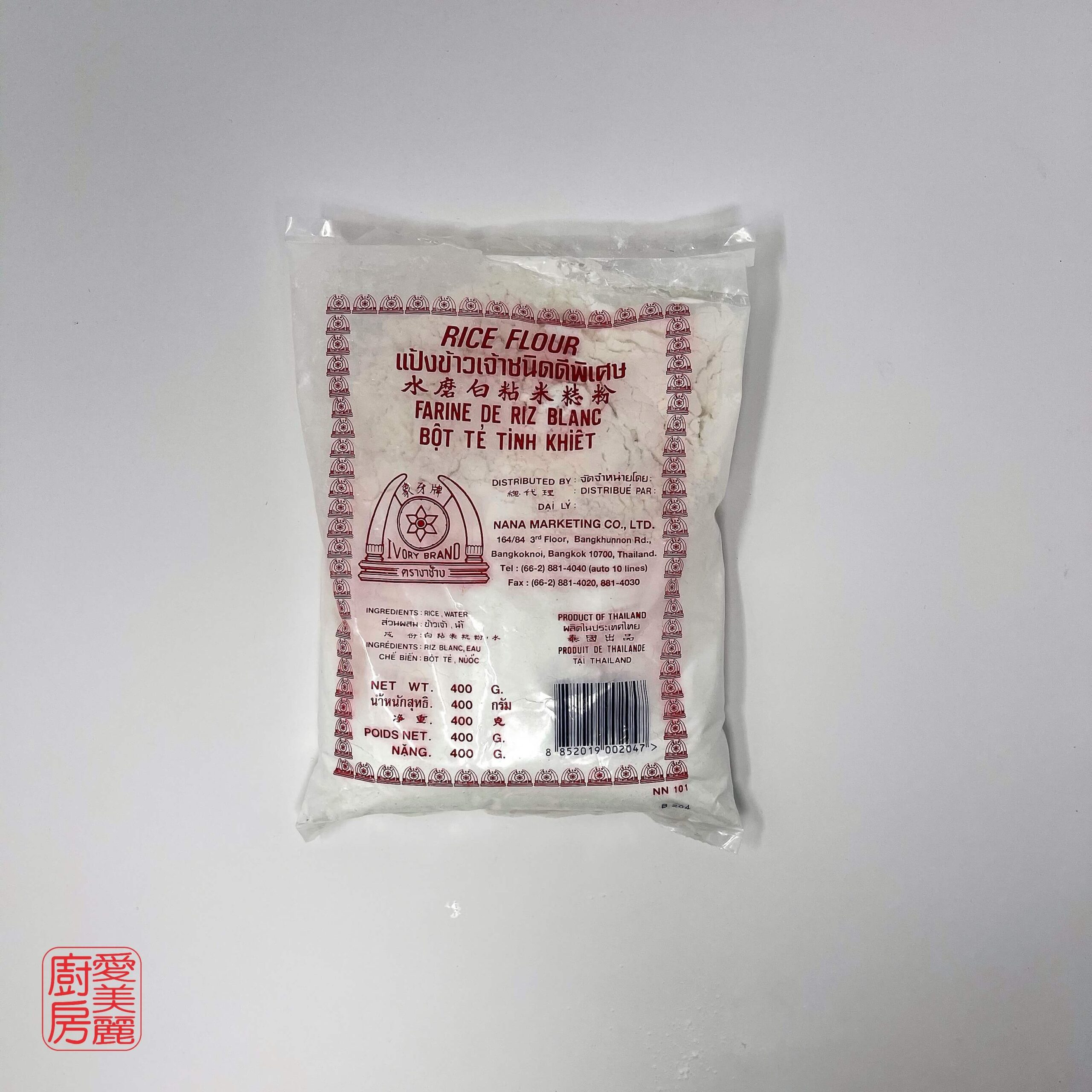
- 150 g Rice flour (NOT glutinous rice flour)
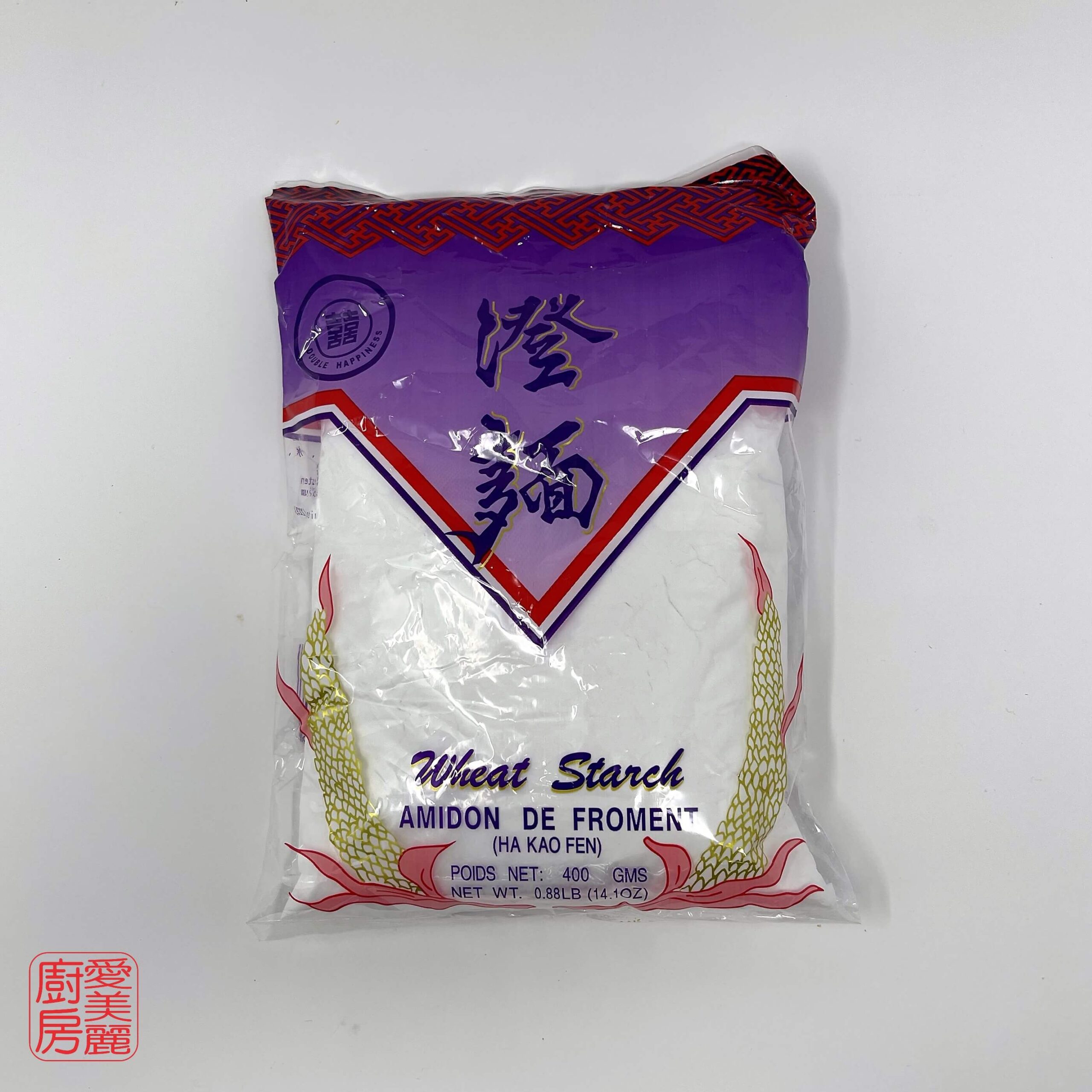
have some extra on-hand for adjustments - 60 g Wheat starch
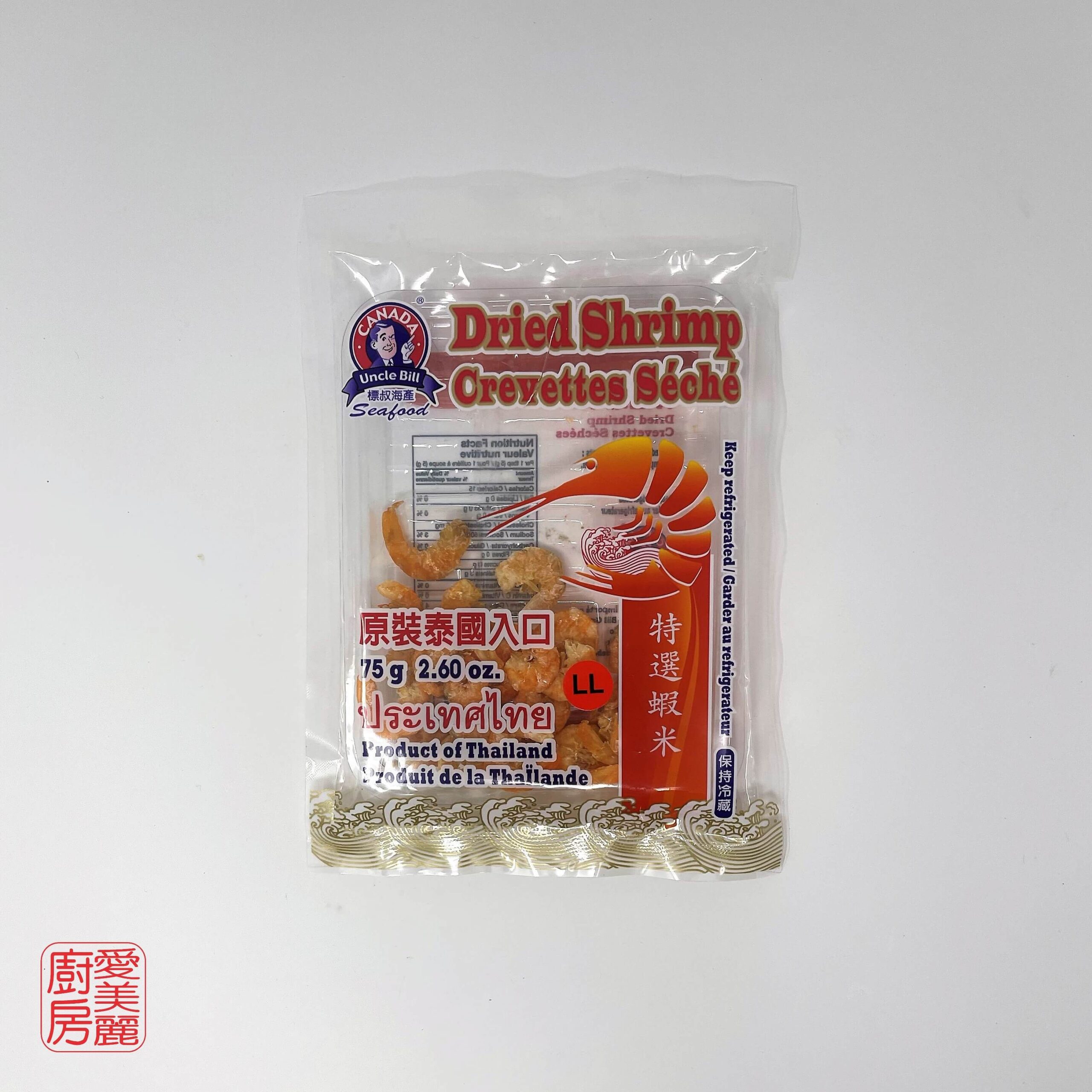
have some extra on-hand for adjustments - 30 g Dried shrimp
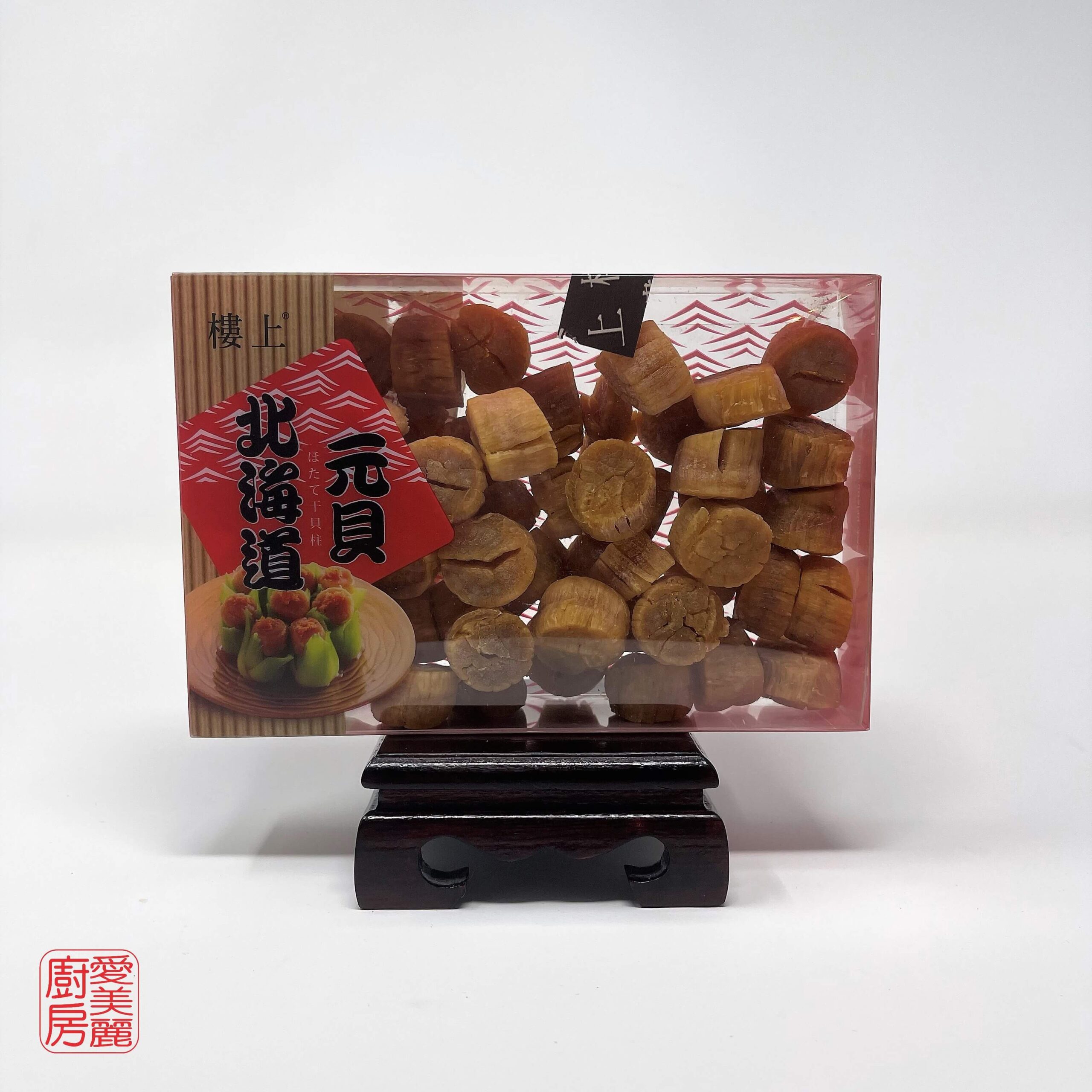
- 20 g Dried scallops (around 4 regular size ones)
- ¾ c Water for soaking dried scallops and dried shrimp
- 30 g Shiitake mushrooms (around 5 large ones)
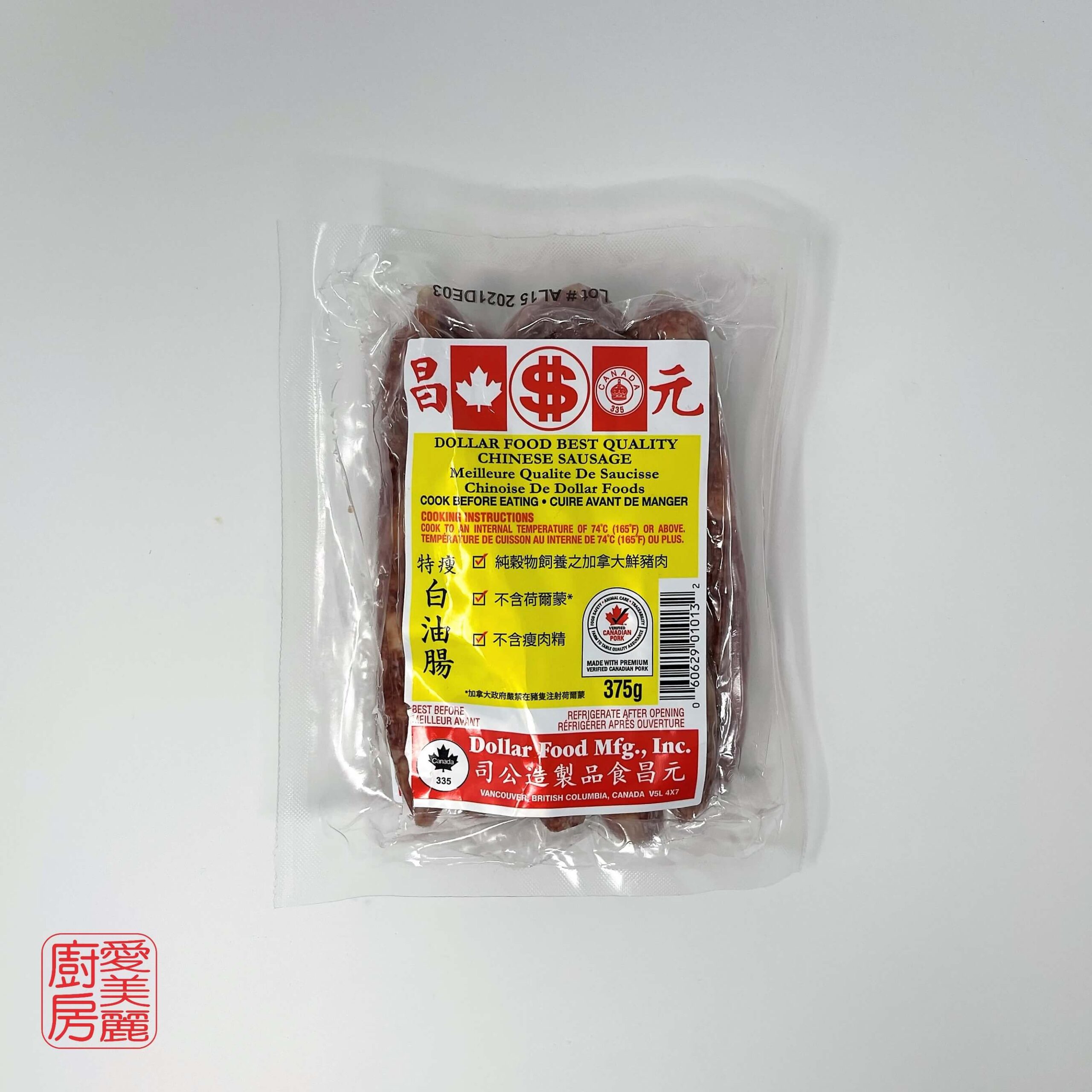
- 2 Chinese pork sausages (lap cheung)
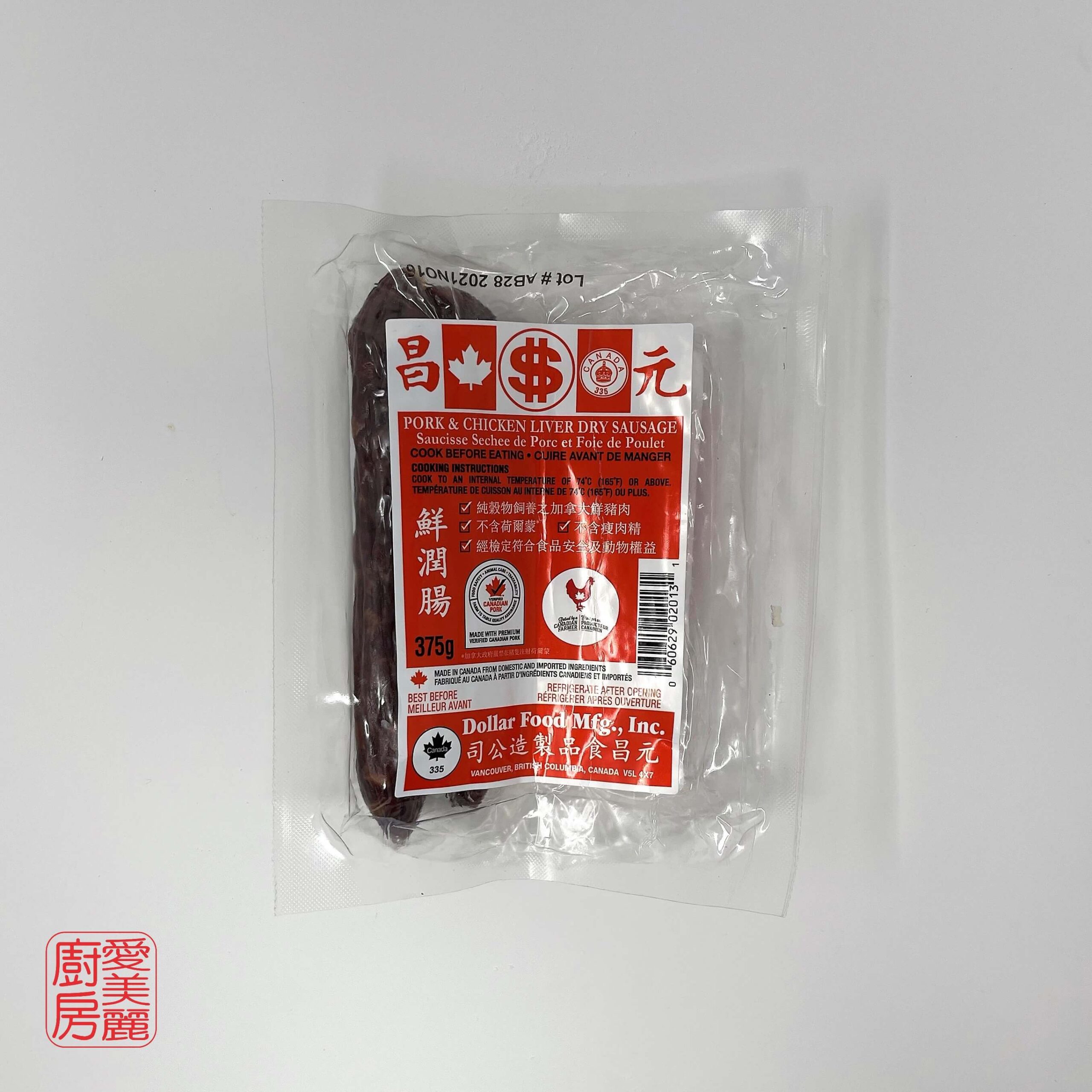
- 2 Chinese liver sausages (yun cheung)
- 1 Shallot (large) or 3 small ones
- 1 stalk Green onions
- ¾ tsp Salt
- ¼ tsp White pepper powder
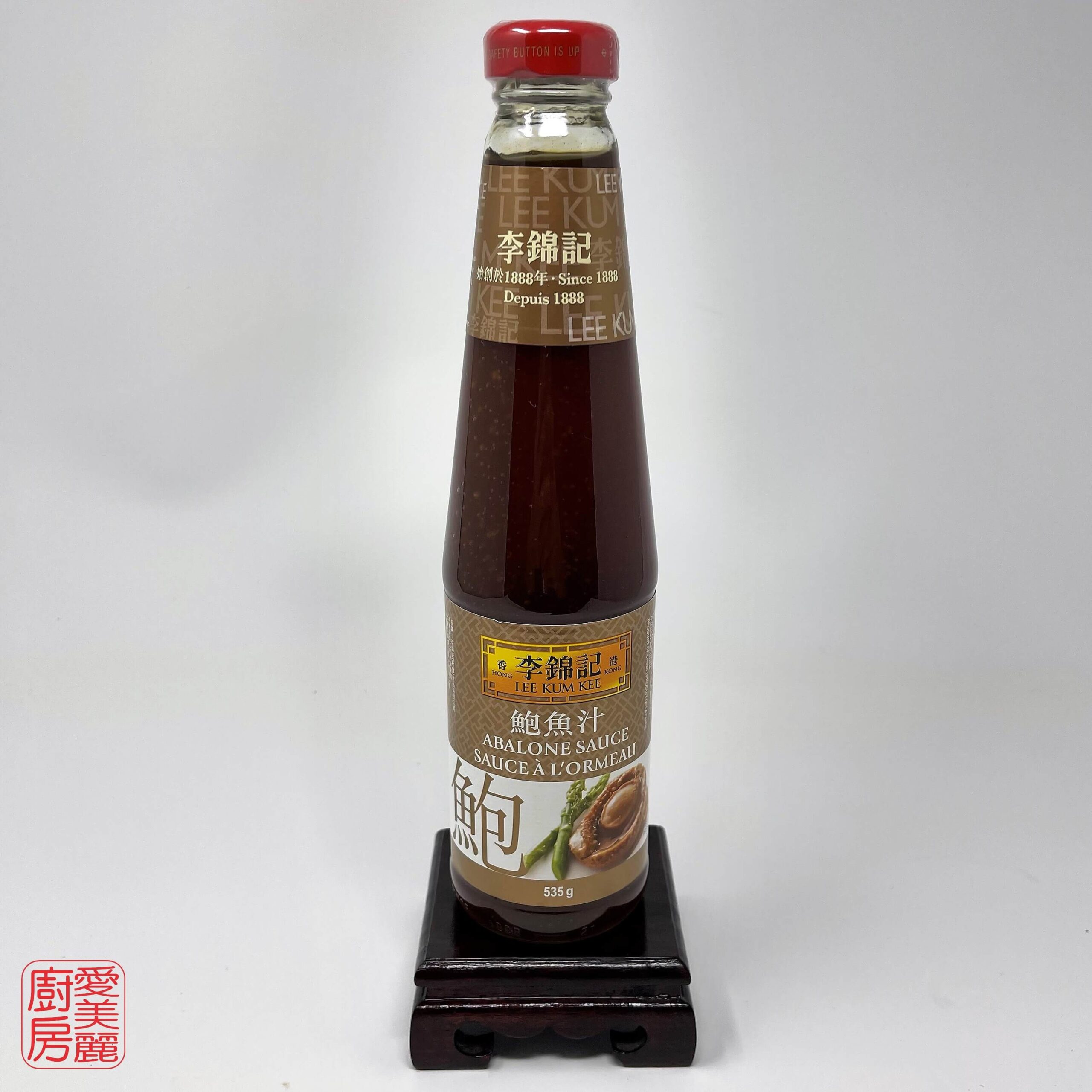
- 4 tbsp Abalone sauce This is great to round out the flavours. It has a subtle dried seafood taste which is perfect for the radish cake. You can also use oyster sauce but the cake will be darker. Chicken broth powder is common too but you’ll have to adjust the salt you add.
- 2 tbsp Shaoxing wine
- 1 tsp Sesame seeds
- ½ tsp Sugar for shitake marinade
- 1 tsp Light soy sauce for shitake marinade
- ½ tsp Cornstarch for shitake marinade
- 1 tsp Oil for shitake marinade
- 2 tbsp Oil for frying
- ½ tsp Oil for brushing on steaming container
Instructions
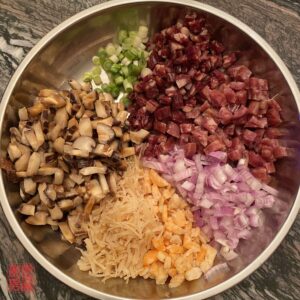
- Night before or 3 hours before: wash 30 g dried shrimp and 20 g dried scallops. Soak them together in ¾ c water. Wash 30 g shitake mushrooms and soak in water
- The next day: SAVE ALL THE SOAKING WATER. Fish out the dried shrimp, dried scallops and shitake mushrooms
- Chop the dried shrimp into smaller pieces and set aside
- Use the side of a cleaver or bottom of a spoon and press down on the scallops to loosen the fibers holding them together. Tear the scallops into shreds and set aside
- Cut the stem off the shitake mushrooms and discard. Cut into little pieces. Marinate with ½ tsp sugar, 1 tsp light soy sauce, ½ tsp cornstarch and 1 tsp oil. Set aside
- Roughly mince the shallot and set aside
- Chop the green onions. Put the whites with the shallots and the greens in a separate container and set aside
- Use some hot water to soak the 4 sausages for 1 minute. Remove from water and wipe with a kitchen towel.
- Slice each sausage length-wise into quarters and then cut them into little pieces. Set aside

- To summarize: dried scallops, dried shrimp, shitakes, shallots, sausages and white part of green onions all need to be cut into smaller pieces and will be stir-fried
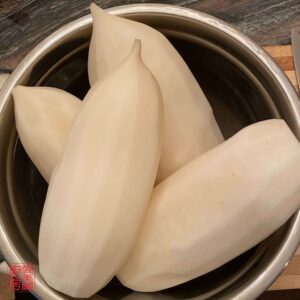
- Cut the tops off the radish and peel the skin with a peeler. If the radish looks somewhat wrinkly on the outside, it may mean that it’s on the dry side and so you’ll want to peel it deeper to remove the fibrous parts. You should be able to see a slightly more translucent colour of the radish when you peel deeper. Nice, fresh radish will look translucent after peeling off one layer
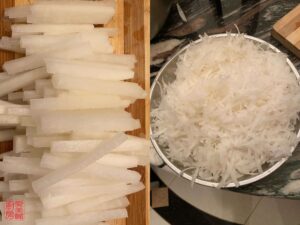
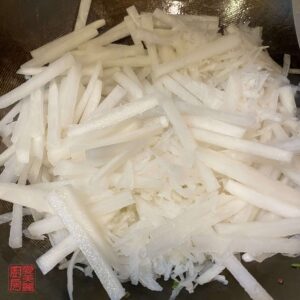
- Take half (500 g) of radish and grate them using a grater. Take the other half and cut them into the size of McDonald’s French Fries that are around 4-5 cm long. Set aside
The grated radish will help to provide the liquid for the cake and the cut ones will give you better texture and radish flavour when you eat it 
- Measure 150 g of rice flour and 60 g of wheat starch in a bowl and mix well. Set aside
The wheat starch is a great buffer to prevent dryness and over watering. It provides a really good texture as well. It’s kind of like insurance! - Prepare the steaming container. Apply ½ tsp oil to the inside of the container with a brush or small piece of paper towel. Set aside
I used an 8” aluminum container plus a small bowl. - Heat your wok to medium-high heat. Add 2 tbsp oil
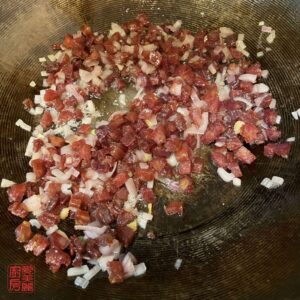
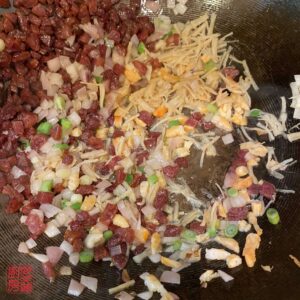
- Add the shallots to the wok. Stir-fry until aromatic
It’s important to add one thing at a time so that the wok doesn’t get cooled too much. If you add an ingredient and you don’t hear the sizzling, then your wok isn’t hot enough and you may end up getting too much steam resulting in your food getting braised rather than fried. - Add all the cut sausages to the wok. Stir-fry for approx. 30 seconds or until aromatic. Move the sausages and shallots to one side of the wok or make a well in the middle of the wok
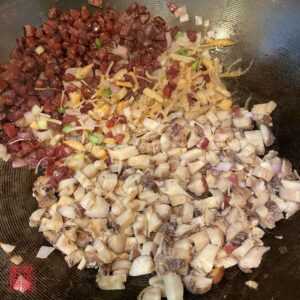
- Add the dried scallops and dried shrimp to the empty space you made in the wok. Stir-fry for 30 seconds by itself and then stir-fry with everything in the wok. Move everything to the side of the wok
- Add shitake mushrooms to the wok. Stir-fry for 1 minute and then stir-fry everything together
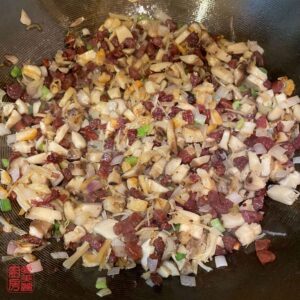
- Add 2 tbsp of Shaoxing wine into the wok. Mix everything evenly
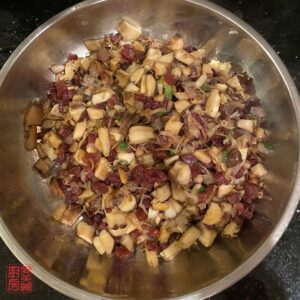
In Chinese stir-frying, we usually add condiments directly onto the wok and not the food so that the condiments can be directly heated by the wok to enhance its aromas - Lower the heat to low and remove the contents of the wok into a container
- Increase the heat to medium-high and let the wok heat up
- Add the radish into the wok. Stir-fry for 1 minute.
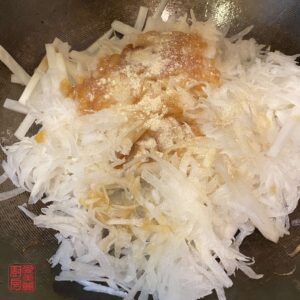
If water has come out of the radish while sitting in the bowl, you can save it for now to see if you’ll need to add it later - Add ¾ c soaking water, ¾ tsp salt, ¼ tsp white pepper and 4 tbsp abalone sauce to the wok
Since we will braise the radish, you can add these directly on the radish. Mix well. - Put the lid on the wok and let it braise for 5 minutes
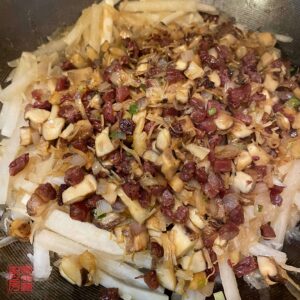
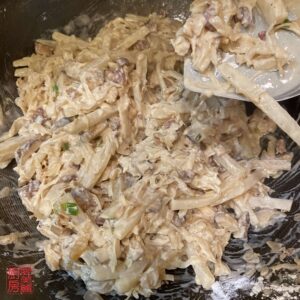
- Remove the lid and add ¾ of the cooked ingredients (sausage, etc). Mix well and turn off heat
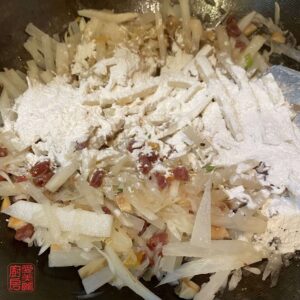
- Sprinkle ¼ of the flour/starch mixture onto the radish and gently incorporate it into the radish. Repeat until all the flour/starch mixture is used
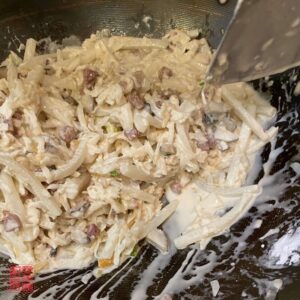
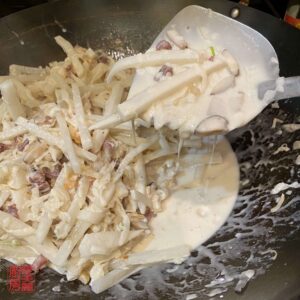
- Since the liquid in radishes may vary, you will need to determine if your mixture is too dry or too watery. When you look at the bottom of the wok, you should see some liquid that has a fairly thick consistency, similar to heavy cream. The liquid should be less than 1 cm high from the bottom of the wok.
- If your cake looks as described in step 28, then go to 33
- If your cake looks dry, so there is very little to no liquid on the bottom, then add some of the saved radish water or shitake water. Add 2 tbsp at a time, mix gently and check again. Do this until you see a bit of liquid at the bottom
- If your liquid is too thin, combine another 50 g of rice flour and 20 g of wheat starch in a bowl, mix well and sprinkle onto the cake and repeat step 27 until you get the right consistency
- If you have too much liquid, your liquid will likely be too thin as well. So you’ll need to scoop out some of the liquid and do step 31.
- Once your cake has the right consistency, prepare your steamer.
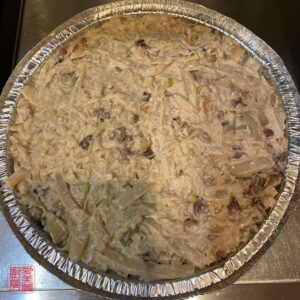
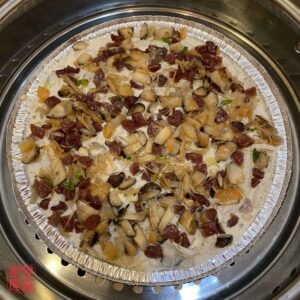
- Transfer the contents of the wok into the steaming container. Leave the liquid on the bottom to add last. As you fill the steaming container, press down gently to remove any spaces. Then add the liquid on the top. Fill to 90%
- Sprinkle the remaining cooked ingredients on top of the cake evenly
- Steam at high heat for 1 hour Make sure you have enough water in your steamer to last 1 hour.
I steamed the small bowl of radish cake in a separate pot for 45 minutes - After one hour, use a chopstick or toothpick to stick into the centre of the cake. Pull it out and see if there is any white residue on it. If there is, then it’s not done. Keep steaming and check again in 10 minutes. If there is no residue or the residue is clear, then the cake is done.
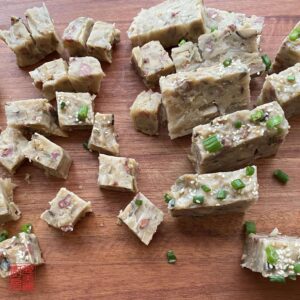
- Turn off the heat, sprinkle sesame seeds and green onions. Let it cool for 15 minutes before serving
- If you’re making fried radish cake, cut it after it has been in the fridge over-night, for best results.
- See my Pan-Fried Radish Cake or my Fried Radish Cake in XO Sauce Recipes for more serving options







This looks totally awesome. I cannot wait to try this soon
Hi Alexandra, I have to say that the steamed radish cake was one of the most difficult recipe I wrote because I kept getting inconsistent results. I must have made it 5 times before I realized that the water content in the radish can vary significantly. Sometimes it'd sit too long in my fridge before I use it and it dries out a bit. Sometimes, they're full of water. So, in my recipe, I show you how to gauge how much water you should have to get good results every time. Adding the wheat starch will also give you added insurance that the texture will come out soft. I can't wait for you to try and let me know what you think! Happy cooking!
I have made my first radish cake yesterday using another recipe. I realized there are several method out there in terms when and how to mix the solids and the rice flour/batter. I will try your recipe next 🙂
Thank you for your detailed instructions and much thought and care you have out into it.
Hi Maple, radish cake is a little tricky to make because of the varying water content of the white radish. I try to show how to determine the right amount of liquid before steaming in the recipe so that you can be successful no matter what kind of white radish you're using. Good luck and happy cooking!