
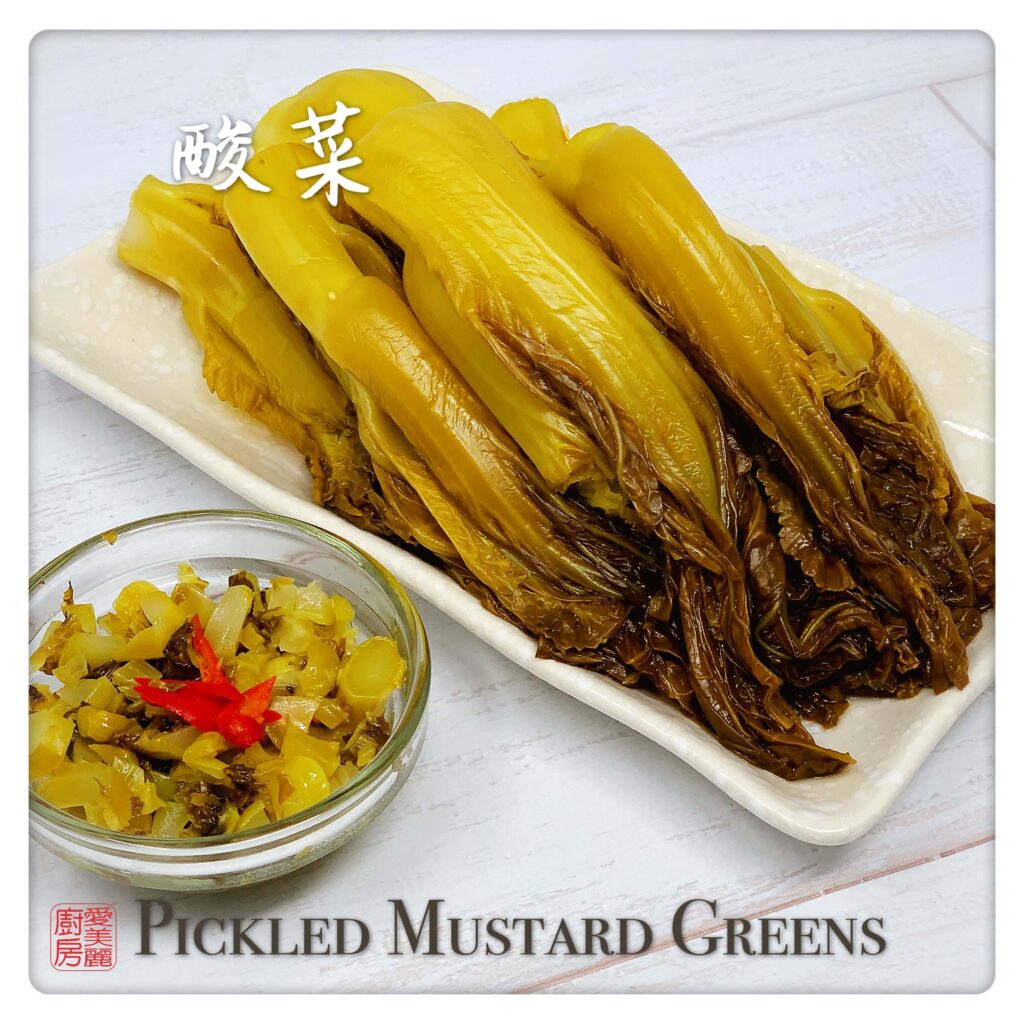
Pickled or preserved vegetables has recorded history in the Rites of Zhou book dated as far back as 700 B.C. Pickled mustard greens 酸菜 (sūan cài) plays a very important role in Chinese cuisine. You can eat it by itself as an appetizer which is an appetite stimulant. You can also cook with it in soup, stir-fried with meat, mixed with cold ingredients to make appetizers. Different regions will use different vegetables and will for varying flavours.
Pickled mustard greens are lacto-fermented so they can provide good bacteria to promote healthy digestion. I prefer to use mustard greens because they are meatier and can be used in a variety of dishes. But you can also use cabbage, radishes, green beans. My favorites are chopping them up and adding them too some noodles in soup, such as Taiwanese beef noodle soup, Hakka-style hand shredded chicken and just adding them to pork or beef stir-fry when I feel like having bold flavors.
My pickled mustard greens 酸菜 recipe does not require air-drying or washing. Mustard greens are relatively clean and so we will only be wiping them clean with a towel. All we add are salt, sugar, and rice water. Then wait 20 days and they're ready to eat. Pickling vegetables yourself is a great way to ensure that you’re eating a healthy product and not something that contains unnecessary additives or preservatives.
You can also customize the flavor to suit your tastes and purposes. If you like it spicy, you can also add a few chili peppers to it. You can store pickled mustard greens in the fridge for 3 months. Make some pickled mustard greens 酸菜 and see how easy it is to make your own lacto-fermented vegetables. Serve them with rice, congee or noodles. They’re also great in a Chinese hamburger and sticky rice with deep fried Chinese donuts (油條, yóu tíao). Try using my Taiwanese Beef Noodle Soup recipe and my Handmade Noodles recipe together with pickled mustard greens for the ultimate taste experience!
Pickled Mustard Greens 酸菜
Ingredients
Ingredients to make 3.3kg of pickled mustard greens
- 4.5 kg Pickled mustard greens
- 167 g Course sea salt
- 33 g Rock sugar (cane)
- 600 ml Rice water
- 4.8 litre Glass jar and a clean rock, plate or bowl that can be used as weight inside the jar to prevent the vegetables from floating above the water
- 1 pair Plastic gloves for food preparation
Instructions
- Estimate the amount of rice water you’ll need and start saving it for pickling. The rice water can last a few days if you boil it, let it cool and store in the fridge. If you don’t have enough, you can always make some with some rice flour
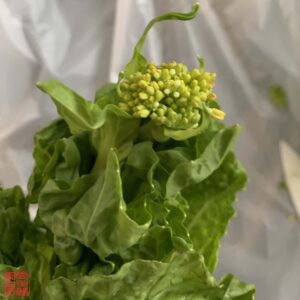
See notes below for how to make rice water - Clean vegetables by using a dry towel. Have a bowl of cooled boiled water on hand in case you need to use some water to clean off dirt. At the same time, remove the flower buds and yellow leaves from the vegetables.
Flower buds on vegetables are said to be nesting grounds for insects 
- After cleaning and culling the vegetables, weigh them to calculate how much salt and sugar you need
- Use all of the rice water you saved to melt the rock sugar. Let cool and set aside. If you're not adding the rock sugar, you will still need to bring the rice water to a boil and let it cool
- Boil around 2 litres of water in a pot. When the water is boiling, place the vegetable in the pot one head at a time, putting the head first and then leaves. Remove after 4-5 seconds or when the vegetable changes to a bright green colour. Continue until all vegetables have been processed. Water must be at a rolling boil when you put the vegetables in
This process helps to sterilize the vegetables - Line the vegetables in a tray and sprinkle the salt evenly onto all the vegetables
- Put on plastic gloves and rub the sprinkled salt into the inside of the vegetable. Rub onto all the leaves and stems as much as possible. Continue for all the vegetables
- Line the vegetables into the jar
- Pour the cooled rice water into the jar until the liquid covers the top of the vegetables
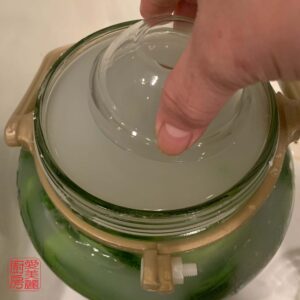
- Weigh the vegetables down with a plate or bowl. Close the jar
- Keep the jar at room temperature away from direct sunlight for 20 days It will be edible after around 6 days, but fermenting for 20 days will allow the lacto-fermentation process to reach its potential

- After 20 days, remove the pickled mustard greens from the jar, discard the liquids and rinse the pickled mustard greens with water then pat dry with paper towels. You can use them immediately or store in the fridge in a ziploc bag for up to 3 months.
- You can chop them up, add sesame oil and some chilis to make a side dish; add them to soup; or add to a stir-fry dish.




Notes
- Do not wash or submerse vegetables in non-cooked (boiled) water. This is a traditional rule that has been passed down for generations. I suspect it’s to prevent bacteria from the water from infiltrating the vegetables and endangering the fermentation process. I don’t think this is as relevant nowadays since most water sources are chlorinated. However, I try to follow with this traditional rule since I could be wrong! If the vegetables are very dirty and you feel you must wash them, then they need to be dried before fermenting.
- For every 100g of vegetable, use 5g of salt and 1g of sugar. Sugar is optional. The sugar must be first melted in boiling water before adding to the vegetables
- The rice water mixture used to submerse the vegetables in must also be cooked. Two methods of making rice water:
- Use cooled boiled water to wash your rice and save the water. The amount of water used should be the same weight as the rice (for example, 2 rice cooker cups of rice weighs approx. 290g, so use 290ml of water) You can use any type of rice. note: 1ml water=1g water
- Use rice flour and water mixture. For every 20g of rice or glutinous rice flour, add 80g of water. The rice flour must be toasted in a pan, no oil needed, until golden colour. The water should also be boiled and cooled before combining with the toasted rice flour
I chopped and added it to my noodle soup, not salty at all 👍🏻👍🏻
Hi I made the pickled mustard greens but found it was very salty and was not sour at all.I soaked it for awhile before stir frying and added vinegar.It was good and crunchy.
However I’m a bit confused that I should remove the mustard greens after 20 days and rinse it with water and pat dry.Would rinsing with water cause the mustard greens to get moldy quicker as the brine is rinsed away .
Instead of rinsing with water can I add vinegar to the brine solution and then keep it refrigerated with the vinegar brine.
Please can you clarify on how to store the pickled mustard greens after the 20 day period.
Thank you.
Hi Jeanette! I am confused as to why it's not sour at all. Did you use saved rice water or did you mix the rice flour with water? The only reason that I can think of for why it doesn't taste sour is that the rice to water ratio was not high enough. It's the rice residue that gives it the sourness. I'm sorry that you found it too salty. But the ratios are from a traditional recipe. As for after 20 days, you can keep it in the brine for up to another 1-2 weeks. After that, it'll still be good, but will not be crunchy and will start getting soggy. If you wash it and dry it to get rid of the moisture, it can last in the fridge for at least a month. I've had some of mine in the fridge for 6 months and it has not gone moldy. In your case, since it's not sour at all, I'd soak it in vinegar (and sugar) for 5 days and then do the drying after that. I hope this helps. I'm really sorry that it didn't turn out for you. I've made it many times this way, and it has always turned out sour. I'm going to make it soon and check all my steps again. I'll keep you posted. Thanks for your feedback!
Salt is measured against the blanched greens or from raw? I normally just salt the greens directly and leave it to ferment in its own juices but I'd like to try your version.
For the rice flour version, why is the rice flour toasted first? Won't it give a nutty flavor to the greens?
Hi Jeanette, salt is measured against raw greens. I toast the rice flour to kill any bacteria that might be present. I know a lot of other recipes don't do this, but it's just peace of mind for me. I haven't found any nuttiness taste in it. Happy cooking!